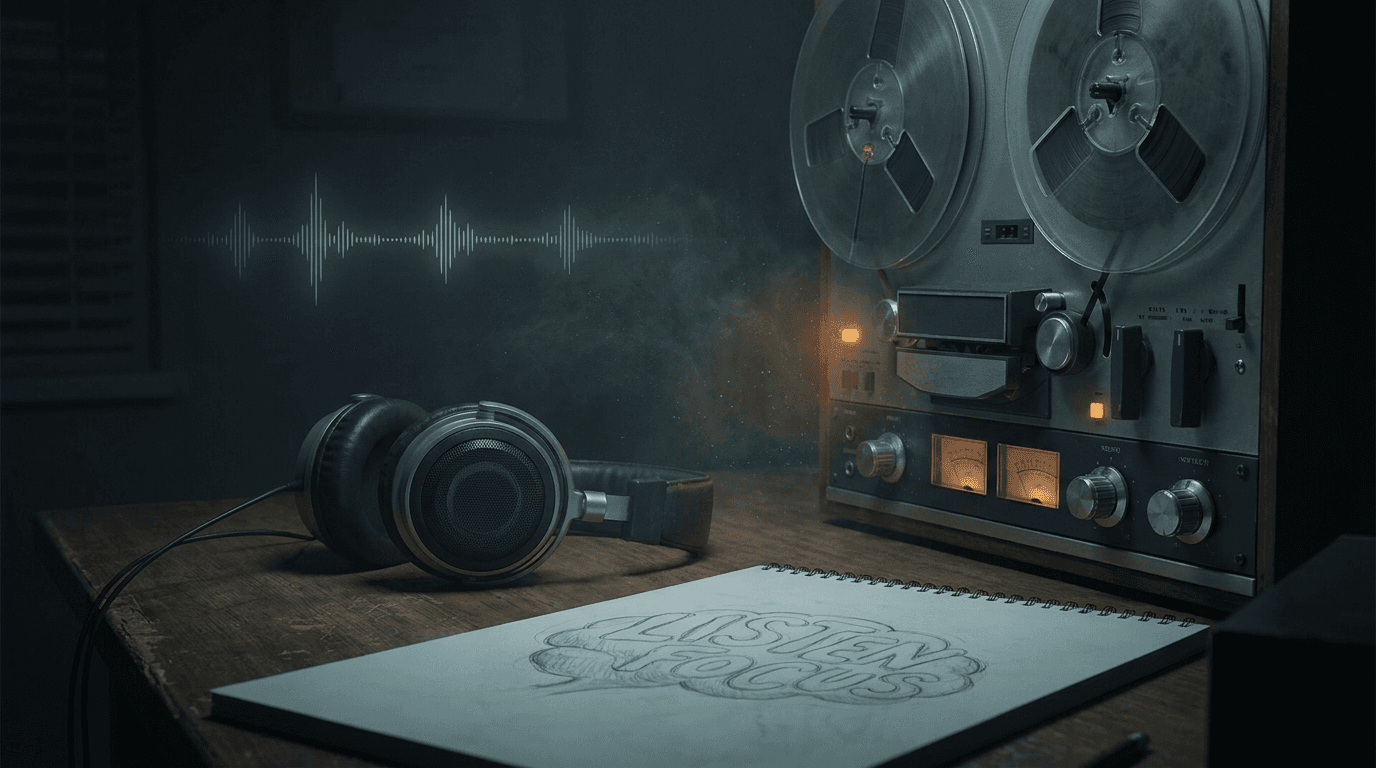
The verbal transformation effect: how your brain hears voices in noise
Even without any audio recording at all, the brain will construct words from static and random sound. Research shows that being told to listen for a voice makes this significantly more likely. What the science of EVP actually found.
Electronic Voice Phenomena — EVP — are sounds recorded during investigations that, on playback, appear to contain voices not audible at the time. They are among the most cited categories of paranormal evidence, and among the most thoroughly studied psychologically.
The verbal transformation effect
Experimental psychology has documented since the 1960s that when people listen to repeated or ambiguous audio — white noise, degraded speech, radio static — the brain's speech-processing system constructs the experience of words from the noise. This is robust and well-replicated. It is the auditory equivalent of visual pareidolia: the speech-detection system evolved to be extremely sensitive, because missing a real warning was costlier than a false alarm, so it inevitably triggers on noise.
What the research found about EVP specifically
A 2015 peer-reviewed study by Nees and Phillips in Applied Cognitive Psychology tested what happens when participants are told in advance that they are about to hear a paranormal EVP recording versus a test of "speech intelligibility in noise." Both groups heard identical audio. The group primed with the paranormal framing reported hearing significantly more voices. Even among those who agreed a voice was present, agreement on the words was very low — exactly what you would expect from pareidolia rather than a real message. A 2022 PLOS ONE study confirmed prior expectation significantly shapes what people perceive in ambiguous data.
What EVP recordings can still tell us
Pareidolia accounts for a large proportion of EVP reports, but properly documented audio — with metadata, baseline noise-floor measurements, chain of custody, and comparison with ambient sources — can identify genuinely anomalous acoustic events worth further analysis. What it cannot do, without that framework, is reliably carry evidential weight. PRN's Evidence Guides cover what good audio documentation looks like.
Sources: Nees, M. A. & Phillips, C. (2015), "Auditory Pareidolia," Applied Cognitive Psychology, 29, 129–134; PMC9473424 — PLOS ONE (2022); Wikipedia — Electronic voice phenomenon.