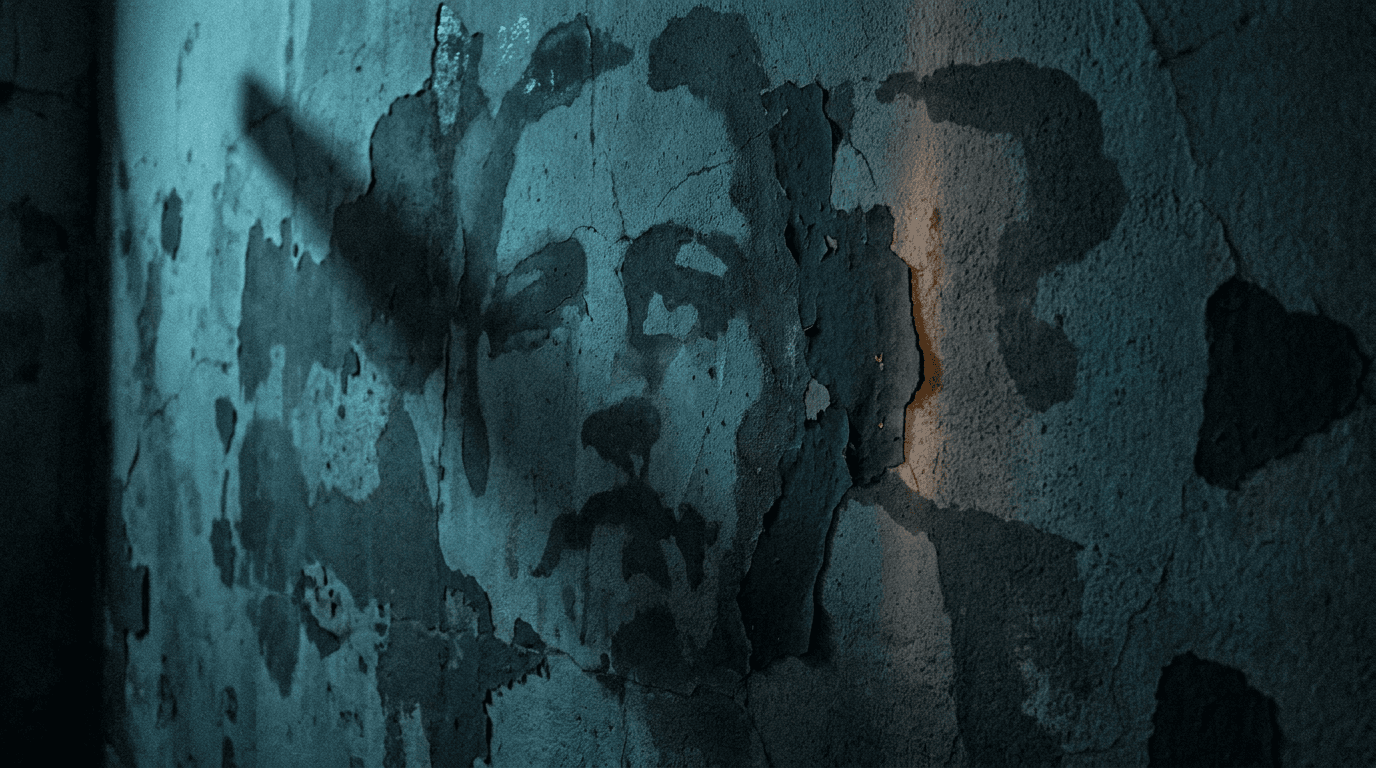
Pareidolia: why we see faces in the dark
Your brain runs a face-detection programme so powerful it fires on wood grain, shadows, and wallpaper patterns. Understanding pareidolia does not make reported experiences less real — it makes them more interesting.
You are alone in a dimly lit room and notice, in the wallpaper or a shadow, what appears unmistakably to be a face. The experience can be startling. It can also be explained by one of the most studied phenomena in cognitive neuroscience.
What pareidolia is
Pareidolia is the perception of a meaningful image — most commonly a face — in an ambiguous or random stimulus. It has a straightforward neural basis: the brain contains a dedicated face-detection system centred on the fusiform face area, which evolved to identify human faces so reliably that it runs automatically and with a strong bias toward false positives. Evolutionarily, it is safer to see a face where there is none than to miss one where there is.
What the neuroscience shows
Neural imaging research in Nature Scientific Reports (2024) confirms that perceiving faces in non-face objects engages the same ventro-temporal circuits, with the same timing, as perceiving real faces. Work in PLOS Computational Biology (2025) found that even deep neural networks develop the same false-positive face-detection behaviour — suggesting this is a feature of pattern-recognition systems generally. There are meaningful individual differences: sensory sensitivity, prior belief, and emotional state all modulate the strength of pareidolia.
What this means for reported evidence
When a face appears in a photograph, shadow, or reflection, the honest first question is whether pareidolia accounts for it. Usually it does. Checking involves viewing the image in context, rotating it, desaturating the colour, and asking whether the "face" is still compelling once those cues are removed. Noting that pareidolia explains an image is not dismissing the person who reported it — it is a feature of a perceptual system doing exactly what it was built to do.
Sources: Nature Scientific Reports (2024), doi:10.1038/s41598-024-60892-z; PLOS Computational Biology (2025), doi:10.1371/journal.pcbi.1012751; PRN Evidence Guides — Video & Photographs.