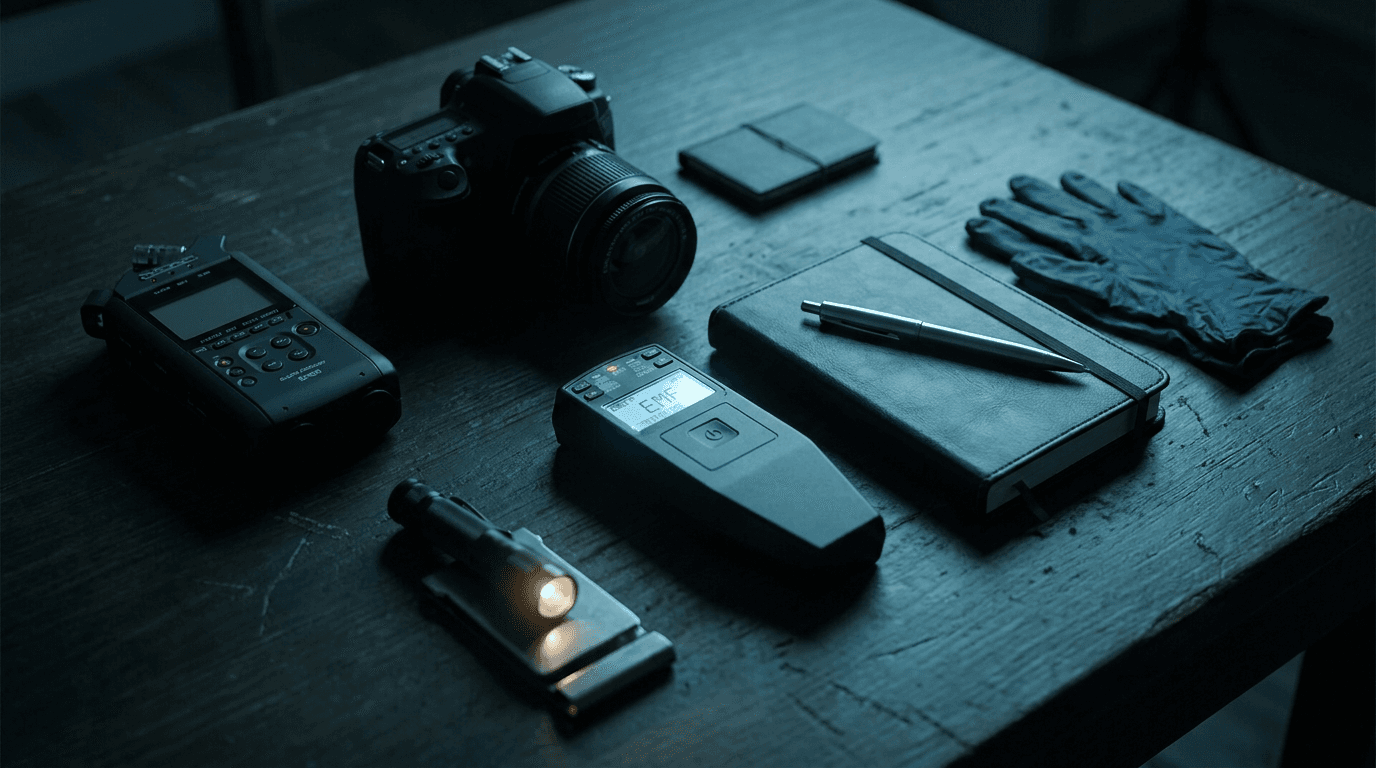
How to record evidence that holds up to scrutiny
Capturing something on camera or audio is only the first step. What separates useful evidence from noise is everything that happens before, during, and after the recording. PRN's practical framework.
One of the most common mistakes in investigation is treating the moment of capture as the evidence. A photograph, recording, or meter reading is data. Whether it constitutes evidence depends on everything around it: what was ruled out beforehand, how the capture was documented, and the chain of custody afterwards. Without that context, the most dramatic footage is essentially unverifiable.
Before you record: establish a baseline
Every location should have a documented baseline: ambient temperature range; ambient EMF from known electrical sources; acoustic background (HVAC, traffic, settlement); and visual conditions including reflective surfaces, infrared sources, and lighting. Without a baseline there is no reference point against which to measure a deviation. A reading that looks anomalous in isolation may be the building's normal behaviour.
During capture: document the context
Chain-of-custody principles, adapted from forensic practice, require a record of who collected each item, when, under what conditions, and how. Note device make, model, and settings; the time correlated with any co-running audio or video; and the positions of all investigators. Retain the original file — do not overwrite it or apply edits to the working copy. Preserve EXIF metadata, and note if smartphone Night Mode or computational photography was active, since these introduce processed artefacts.
After capture: rule out before you conclude
For each anomaly type, work through natural and technical explanations from most to least common. Photographs: flash backscatter, lens flare, compression artefacts, computational-photography effects. Audio: auditory pareidolia, radio-frequency contamination, building sounds, the recorder's own noise floor. Meters: known electrical sources, interference from other equipment, baseline levels. An unexplained result — one that survives all checks — does not confirm a paranormal cause; it means the cause has not yet been identified. That is the honest conclusion, and a more valuable one than a premature claim. PRN's four Evidence Guides (Photographs, Audio, Video, and Meters) walk through each step in full, free to read in PRN's Evidence Guides.
Sources: PRN Evidence Guides; NIH/NCBI StatPearls — Chain of Custody (NBK551677); PRN Evidence Standards Hub — Method Library.