Ghost Hunting Gadgets: What Actually Works (and What’s Just for TV)
Walk into any "haunted" location with a ghost hunting team today and you'll see an impressive array of equipment: EMF meters, thermal cameras, spirit boxes, REM pods, and digital recorders. But how mu
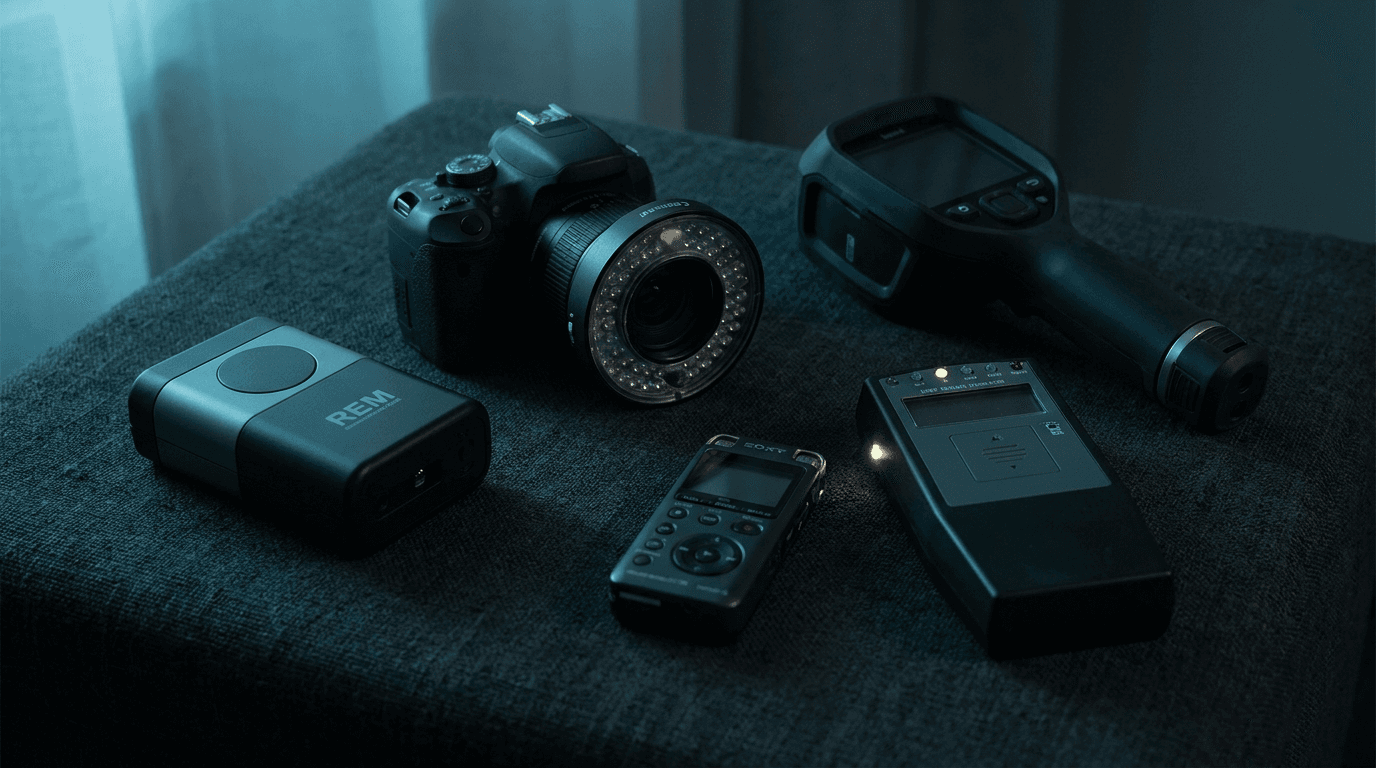
Walk into any "haunted" location with a ghost hunting team today and you'll see an impressive array of equipment: EMF meters, thermal cameras, spirit boxes, REM pods, and digital recorders. But how much of this actually helps us understand what's going on — and how much is just for show?
The answer is more nuanced than many people realize.
The Rise of the Ghost Hunting Toolkit
Most of the equipment used by amateur investigators today became popular because of paranormal television shows. Devices that were once obscure or used for other purposes suddenly became "ghost detectors" in the public imagination.
The most common tools you'll see are: - EMF meters (measure electromagnetic fields) - Digital voice recorders (for capturing EVP — Electronic Voice Phenomena) - Thermal cameras (detect temperature differences) - Spirit boxes (rapidly scan radio frequencies) - REM pods and motion sensors
What the Science Says
When researchers have actually tested these tools under controlled conditions, the results are sobering:
Most readings have normal explanations. EMF meters pick up fields from wiring, appliances, and even the investigators themselves. Thermal cameras show temperature differences caused by drafts, insulation, or body heat. Spirit boxes produce audio fragments from radio stations that listeners then interpret as voices.
Expectation heavily influences interpretation. Studies on auditory and visual pareidolia show that when people expect to hear voices or see figures, they are dramatically more likely to perceive them in ambiguous data.
Proper scientific use is rare. Many amateur investigators don't establish proper baselines, don't use calibrated equipment correctly, and don't apply blind analysis to their recordings. Without these controls, it's very difficult to know whether a "spike" or "voice" is actually unusual.
What Does Work Better?
Some approaches are more scientifically grounded:
- Environmental monitoring — Measuring temperature, humidity, electromagnetic fields, and infrasound over time with proper data logging can reveal patterns.
- Controlled experiments — Rather than wandering around hoping to capture something, structured experiments with clear hypotheses and controls produce more reliable data.
- Multiple independent witnesses + documentation — Good old-fashioned careful observation with contemporaneous notes remains one of the strongest methods.
Laboratory parapsychology uses very different tools (random number generators, Ganzfeld setups, physiological monitoring) designed for controlled testing rather than "ghost detection."
The Bottom Line
Consumer ghost hunting equipment can be fun and sometimes helps people feel more connected to an investigation. However, as currently used by most amateur teams, it rarely produces data that can withstand scientific scrutiny.
The most credible research combines careful environmental measurement, psychological awareness, and rigorous methodology — not just flashy gadgets.
Want the Detailed Research?
Download the full paper on this topic: - Instrumentation & Equipment in Paranormal Research
It goes much deeper into the science behind the tools and what actually constitutes good evidence.
Have you used any of this equipment yourself? What was your experience?
Making paranormal research accessible — one topic at a time.