Historical Origins
The banshee — Irish bean sí, from the older ben síde, "woman of the otherworld mound" — is the supernatural female death-messenger of Irish tradition, whose cry or lament is said to warn certain families that a death is imminent. The tradition is documented as folklore: a body of belief and narrative, not a verified phenomenon. The figure's roots are usually traced to medieval Irish literature, in which women of the síd (the otherworld dwellings of pre-Christian tradition) appear as supernatural patrons and prophets attached to particular territories and dynasties. Several distinct medieval figures fed the later tradition: territorial otherworld women such as Aoibheall of Craig Liath, who in the medieval account of the Battle of Clontarf (1014) — preserved in the twelfth-century text Cogadh Gáedhel re Gallaibh — is said to have foretold the death of Brian Boru; and death-foreboding female figures such as the badb and the "washer at the ford," who appears in early literature washing the bloodstained garments of those about to die. None of these is yet the banshee of later folklore, and the date at which the modern death-messenger belief crystallised is unknown, but the components are demonstrably old.
The earliest clearly datable first-person testimony usually cited is that of Lady Ann Fanshawe, an Englishwoman who stayed in Ireland in 1642–1649: her memoirs (written in the 1670s, published 1829) describe a wailing apparition at a window in an O'Brien household on the night a kinsman died. By the seventeenth and eighteenth centuries the anglicised word "banshee" was entering English usage, and Sir Walter Scott discussed comparable household death-spirits of Highland families in Letters on Demonology and Witchcraft (1830). The first substantial folklore documentation came with Thomas Crofton Croker's Fairy Legends and Traditions of the South of Ireland (1825), which devoted a section to the banshee; Lady Jane Wilde's Ancient Legends, Mystic Charms, and Superstitions of Ireland (1888) added influential literary retellings, including accounts of the banshee following emigrant families abroad.
Systematic documentation belongs to the twentieth century. The Irish Folklore Commission (founded 1935) gathered banshee material throughout the country, and the Schools' Collection of 1937–1939 — in which schoolchildren recorded folklore from older relatives and neighbours — preserves hundreds of banshee accounts, now digitised by the National Folklore Collection at dúchas.ie (the collection's topic index lists several hundred items under "banshees"). The defining scholarly treatment is by folklorist Patricia Lysaght of University College Dublin: a preliminary survey and a dedicated questionnaire published in Béaloideas 42/44 (1974–1976), followed by her monograph The Banshee: The Irish Supernatural Death-Messenger (1986), based on her doctoral research. Lysaght mapped the tradition's regional names and forms, connected the banshee's lament to the human custom of keening (caoineadh) performed by women at wakes and funerals, and documented the core belief that the banshee attends particular families — predominantly those of old Gaelic stock (Ó and Mac surnames), though some families of Anglo-Norman descent also claimed her.
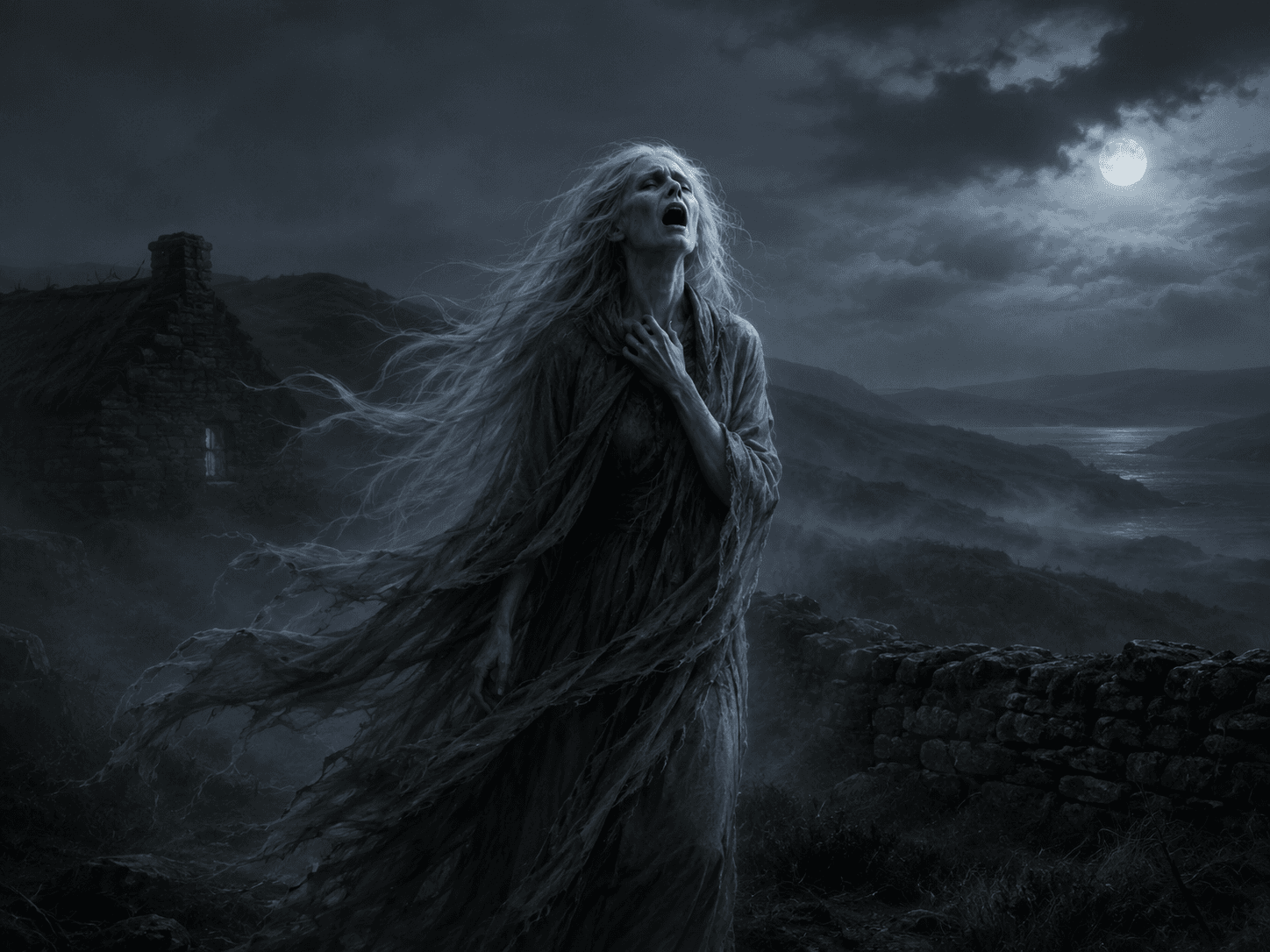
In the documented tradition the banshee is overwhelmingly an auditory experience: a prolonged, mournful cry heard at night, interpreted retrospectively when news of a death arrives. Visual descriptions, where they occur, are usually of a solitary woman, often old, sometimes combing long hair; she does not cause the death she announces, and she is not hostile to those who hear her. The tradition travelled with Irish emigrants to Britain and North America, where family-banshee accounts continued to be recorded into the twentieth century. Popular culture has since reshaped the figure considerably — modern horror films and games commonly depict the banshee as a screaming spectral attacker whose voice harms or kills, an inversion with no basis in the recorded Irish material. Folklore scholarship treats the banshee as a legend complex and belief system of exceptional continuity and documentation; claims of contemporary banshee experiences circulate in paranormal communities but remain testimony, not evidence.