Historical Origins
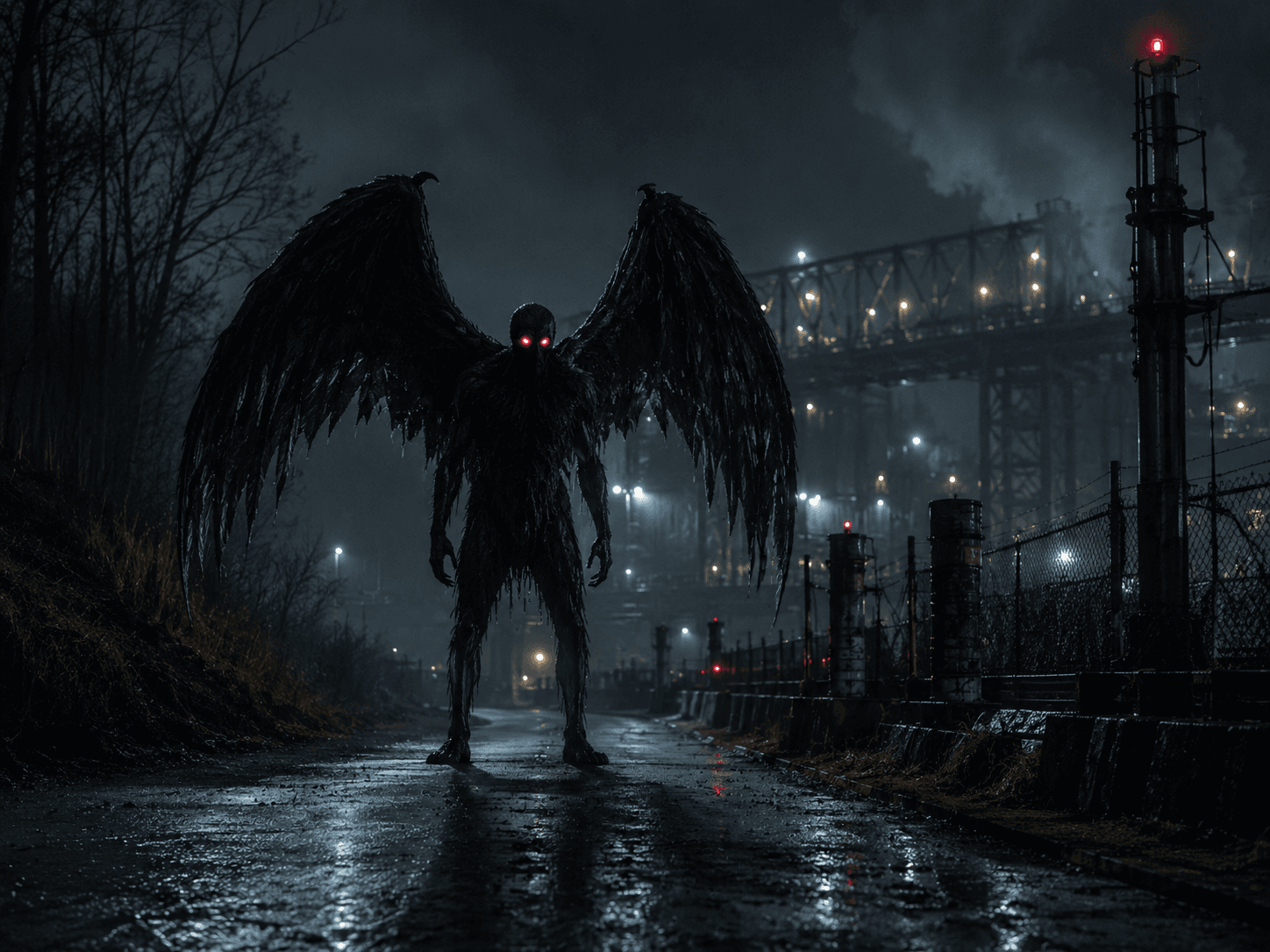
The modern Mothman legend begins on the evening of November 15, 1966, when two young couples — Roger and Linda Scarberry and Steve and Mary Mallette — were driving near the McClintic Wildlife Management Area north of Point Pleasant, locally known as the TNT Area due to its use as a World War II munitions storage site. They reported encountering a large grey-winged figure with glowing red eyes near an abandoned generator plant. The creature reportedly followed their car at speeds over 100 mph as they fled toward Point Pleasant. Deputy Sheriff Millard Halstead took their report and found them visibly shaken; he returned to the area the following day and found nothing.
The sighting was not isolated. Over the following thirteen months, more than a hundred residents of the Point Pleasant area reported encounters with the creature. Reports came from farmers, police officers, housewives, and teenagers. The consistency of physical description across unconnected witnesses — particularly the red, self-illuminated eyes, the grey or brown coloring, and the absence of visible neck — attracted serious investigative attention. Local newspapers, particularly the Point Pleasant Register, covered the sightings extensively. The name "Mothman" appeared in the Charleston Gazette on November 16, 1966, borrowed loosely from the Batman television series then popular on American television.
Journalist and paranormal investigator John Alva Keel arrived in Point Pleasant in December 1966 and conducted sustained fieldwork through 1967. Keel interviewed dozens of witnesses and catalogued the Mothman alongside a broader wave of UFO sightings, Men in Black encounters, and poltergeist activity that he believed formed a coherent pattern. His 1975 book The Mothman Prophecies (Saturday Review Press / E.P. Dutton) presented the Mothman not merely as a creature but as a component of what he termed "ultraterrestrial" intelligence — entities that interact with human consciousness and may manifest in culturally conditioned forms. Keel's framework, though controversial, drove the creature into the mainstream of paranormal literature.
The Silver Bridge, a 1928 eyebar-chain suspension bridge connecting Point Pleasant to Gallipolis, Ohio, collapsed without warning during rush-hour traffic on December 15, 1967. Forty-six people died; many vehicles fell into the Ohio River. A subsequent National Bureau of Standards investigation attributed the collapse to a stress-corrosion crack in a single eyebar link that had gone undetected for years — a structural failure, not a paranormal event. Nevertheless, witnesses later recalled Mothman sightings near the bridge in the weeks preceding the collapse, and the association between the creature and the disaster became fixed in popular memory. Some researchers, including Keel, noted that Mothman reports in the area ceased almost entirely after the bridge fell.
The TNT Area — approximately 2,500 acres of forested, partially contaminated land containing concrete igloo-shaped ammunition bunkers — remained the epicentre of sightings throughout the thirteen-month flap. The area is genuinely unusual: wartime chemical and explosive contamination, abundant wildlife, and a network of tunnels and bunkers that create disorienting acoustic and visual conditions at night. Investigators have noted that the site's history of industrial contamination, its isolation, and its liminal position between inhabited and wild land make it a psychologically potent location independent of any paranormal hypothesis.
Subsequent decades produced Mothman reports from locations far removed from West Virginia. Workers at the Chernobyl nuclear plant reportedly described seeing a large dark winged figure in the days immediately preceding the April 26, 1986 reactor explosion. These accounts are secondhand and difficult to verify independently; they were reported by journalist Linda Moulton Howe among others but have not been confirmed by primary documentation. A wave of sightings in the Chicago metropolitan area beginning in 2017 was catalogued by researcher Lon Strickler of Phantoms and Monsters; Strickler documented over 50 reports between April 2017 and the end of 2018, describing a large winged humanoid seen near the lakefront, O'Hare Airport, and city parks. The Mutual UFO Network (MUFON) independently received a subset of these reports.
The Mothman became a significant cultural and economic presence in Point Pleasant. The Mothman Museum, located at 400 Main Street, opened in 2005 and houses newspaper clippings, witness statements, props from the 2002 film adaptation of Keel's book, and a research archive. A twelve-foot stainless steel statue by artist Bob Roach was installed in the town in 2003. The annual Mothman Festival, inaugurated in 2002, draws thousands of visitors each September.